At a course I met the owner of a manufacturing company who was trying to work out why his people never bring any improvements. He would like to automate more in the company and try AI as well, but the team resists anything new. When I asked why, his answer was roughly this: They don’t see a reason why. They’re people set on doing their part and going home.
Start with people, then look at process and technology and assess them using four options: keep, fix, replace, or retire.
People, process and technology
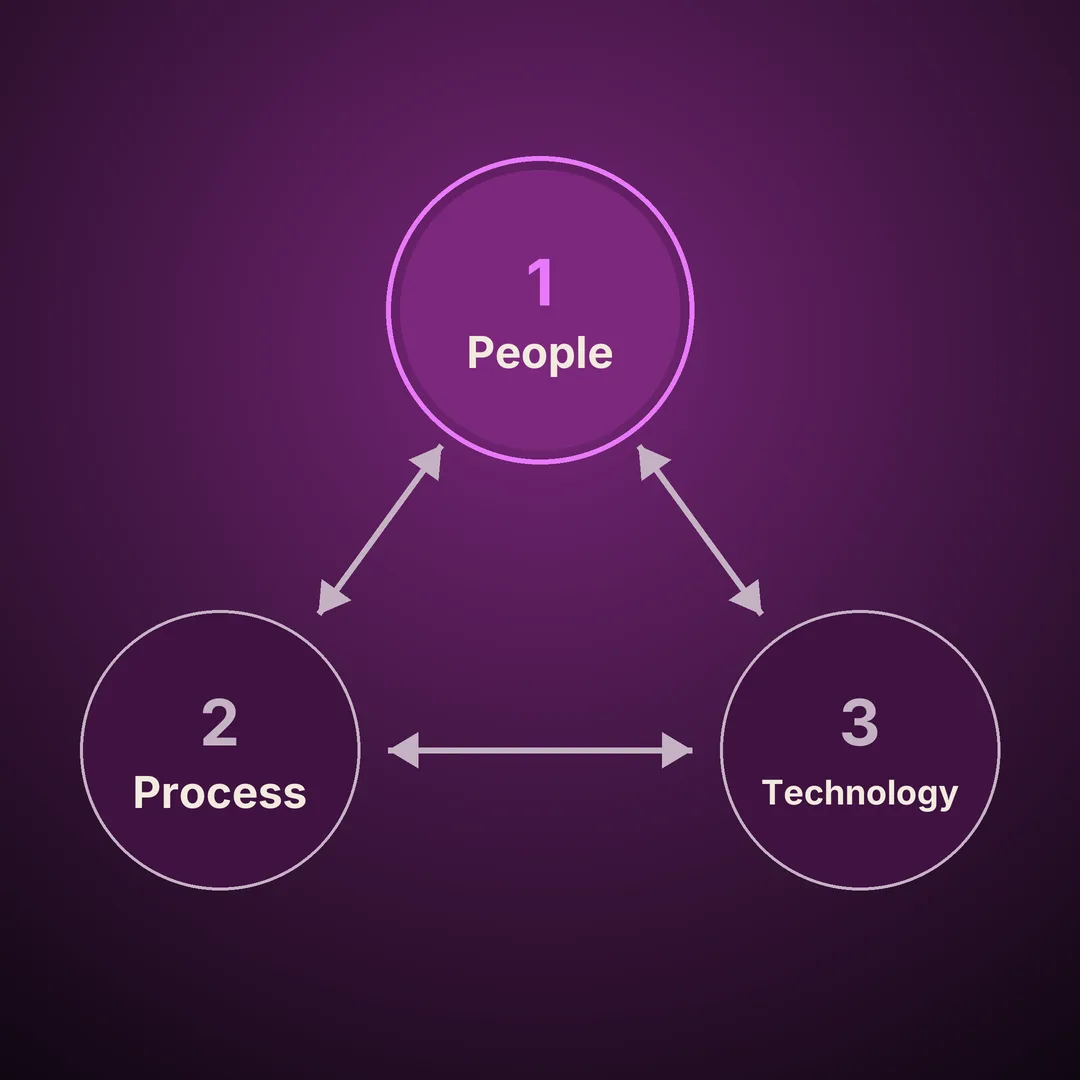
Use a simplified triangle of people, process and technology. People are the ones who do the work. Process is how they do it, who hands what over to whom and who approves. Technology is the tools they use to do it.
When you move one of them, the others move too. Once you know that, you deal with them deliberately and don’t leave it to chance that the remaining sides of the triangle will somehow click into place on their own.
Companies often do it the other way round. They buy a tool and only then adapt people and workflows to it. Start with this part of the triangle: people first, then process, and technology last.
For the owner of the manufacturing company, technology was the goal. But things were stuck on the people and on how the system for improvements was set up, and that is process.
1. Start with people
The owner of this company was tempted to start with machines, because they can be bought, installed and ticked off, whereas people and the way they work together are not that simple. But a new machine won’t give people motivation. On the contrary, by bringing in a tool as the first step, in a company set up like this you can deepen the problems: disrupt how people work together, demotivate them, trigger negative emotions or resistance.
With the owner, we first looked at who is on the team and with what mindset they come to work. They know it best themselves, so ask your people what gets stuck in their work and what they would change.
The team was missing a person with a change mindset who, with the owner’s support, would help transform the rest of the team.
This is how we eventually arrived at the first step: develop someone into a leadership role and gradually bring in people who think differently and will spark change from within the team, and they don’t necessarily have to be the young ones. A new process and technology will then come together around the new team.
2. Then assess process and technology: keep, fix, replace, or retire
Look at the process of working with people: how you motivate them to bring small improvements, how you respond to them and whether the company culture is set up for it. I would start with these questions: What happens when someone brings an improvement? Who can actually suggest one today? And has the owner himself told them why he wants to automate and what’s in it for them?
At the course, I brought the core of Baťa’s philosophy into the discussion, where even small improvements are rewarded. A reward for improvement, which doesn’t have to be only financial, gives people the reason they are missing today.
When you know where things get stuck (in the process, in the technology), you don’t have to choose only between “redo everything” and “leave it be”. You can assess process and technology each on its own and choose whether to:
- Keep, when it serves you and takes you where you want to go.
- Fix, when it makes sense, it just doesn’t work the way it should. For example, people don’t use a tool because nobody properly showed them how to work with it, or because it’s set up differently from how they’d need it to work in practice.
- Replace, when it still works somehow, but in these fast-moving times it no longer keeps up with the company’s growing needs.
- Retire, when it takes more than it gives, whether time, money or people’s attention. Even when you’ve put a lot of work into it. How much work has already gone into it doesn’t mean you should keep going.
And then come back to people
Whichever of these paths we choose, in the end people will be the ones working with it. And they don’t hold on to the old way because it’s faster, but mostly because it’s ingrained. That’s why after every change, let’s check whether someone has rebuilt the old way on the side, in their own spreadsheet or on paper. If they have, people are telling us that we haven’t yet solved part of what they needed, or that they’re lost in how to work with it. But we only find that out by talking to people or shadowing them at work.