Aloha 👋🏻
Welcome to the On the Waves of Change newsletter. The place where quiet people find their voice.
You would expect someone who builds robots to be the first to see the risks, wouldn't you?
Standa is the exact opposite. He is not afraid they will take our jobs. He is afraid of something else - that we will lose what is human in us.
Today's lines belong to Stanislav Věchet, associate professor at the Faculty of Mechanical Engineering at Brno University of Technology, where he heads the bio-inspired robotics laboratory.
He has done karate since he was eight. He has been travelling to Taiwan for fifteen years and feels at home there. In his fifties he does parkour, and he is a father to two daughters.
He understands machines and artificial intelligence. And he is worried that somewhere in all of it we might lose what is ours - what is human.
We keep talking about artificial intelligence. But do we know what our own natural one is?
The media scare us that robots will wipe us out and AI will take our jobs. Standa builds those robots every single day, and he does not tell terrifying stories. The further we went in the conversation, the less it was about machines and the more it was about us.
What came up in the conversation (and why it is worth a listen):
"Behind everything, look for the human"
When I asked him what he says to people who are afraid technology will destroy us, he answered in a single sentence.
"Behind everything, look for the human."
The way he sees it, we swing from one extreme to the other far too easily. "AI will wipe us out" is exactly that kind of extreme - just like when the first machines arrived and everyone shouted that we would all lose our jobs. The labour market is changing, yes. But slowly, not overnight.
The robot that "kicked a child" knows no kung fu at all
You have surely seen that video. A humanoid robot kicks a child and the internet loses its mind. Standa explains it in plain terms.
"He is doing kung fu, but he knows no kung fu at all. He is only copying a routine. He has no idea where he is - or that a child is standing there."
The robot is remote-controlled, copying a learned movement, and it knows nothing about the space around it. We attribute qualities to machines that they simply do not have.
Digital dementia is setting in
If we use artificial intelligence for very nearly everything, are we heading towards digital dementia?
"When someone starts losing their memory, the first thing that occurs to them is: I will look it up on Google."
We are giving up using our brain for the thing it is best at - solving problems we have never seen before. And he asks: what will you do when one day the AI is not there?
Could you work out the answer today without AI or Google?
Treat AI like a librarian
That does not mean he rejects the tool. He simply gives it a different role.
"You should treat it like a librarian. They just hand you the book and suggest which one - but you have to solve it yourself."
The trouble starts when we take a single page from the librarian without any context and stop thinking. Sometimes it works out. Usually it does not, because that one page gets lost without the context around it.
A new tool for persuading the masses
We also talked about whether we might easily become easier to manipulate once we stop carrying our own knowledge in our heads.
"If people want to believe something, they will believe it. Just like people who believe the Earth is flat."
Deepfakes, generated content, AI videos everywhere you look. Standa also sees hope in it: maybe the bubble will burst and people will start longing for the authentic. He has experienced it himself - you know someone from LinkedIn, then you meet them in person and they are a completely different person. The only thing that will really help, he says, is fewer social networks and more real conversations.
What a robot does when nobody is watching
And here is the heart of it. I asked him what building robots has taught him about us, about people.
"When nobody is watching, the robot is switched off."
What is human, in his view, is exactly what the robot does not do: sit down and think about the universe between the lines. Count the bubbles in a fizzy drink, or the clouds. We keep talking about artificial intelligence, but we do not know what our natural one is - what actually makes us thinking beings. We have explored barely five per cent of our own brain. And the neural network inside AI? "A matrix has not become conscious," Standa says.
What else comes up in the conversation?
- How he raises his daughters in a world where a phone can do things their dad cannot,
- whether we really are missing the boat while America and Asia are ahead on AI,
- and the best piece of advice he has ever been given.
And to close, the sentence he sends out into the world:
"That people would take joy in those short moments. Live here and now, and not let themselves drift somewhere they never wanted to go."
Happy reading, happy listening - until next time. 👋🏻
Take good care.
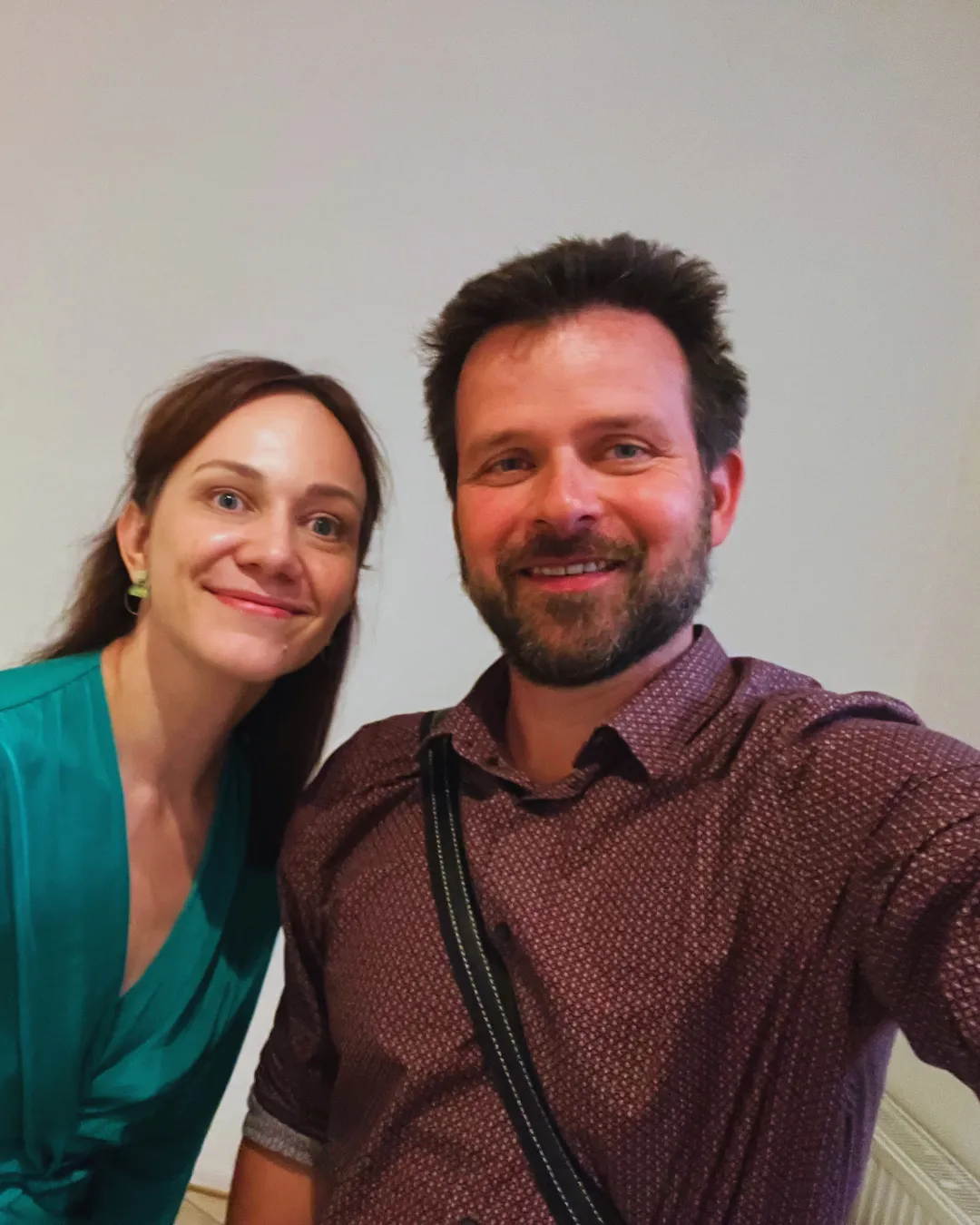
Stanislav and Viki are waving at you.