Aloha 👋🏻
Welcome to the On the Waves of Change newsletter. The place where quiet people find their voice.
Today's lines belong to Tomáš Janík, a clinical development advisor for pharmaceutical drugs. He manages portfolios worth hundreds of millions of dollars, and his decisions often determine whether a drug succeeds or not. Out of thirteen drugs in development, on average only one makes it. And that one has to fund the development of the other twelve, which failed.
He sums it up in one sentence: he lives in the future. What the world sees as new is, for him, already outdated - because the drug he's working on today might not help a patient for another ten, fifteen years.
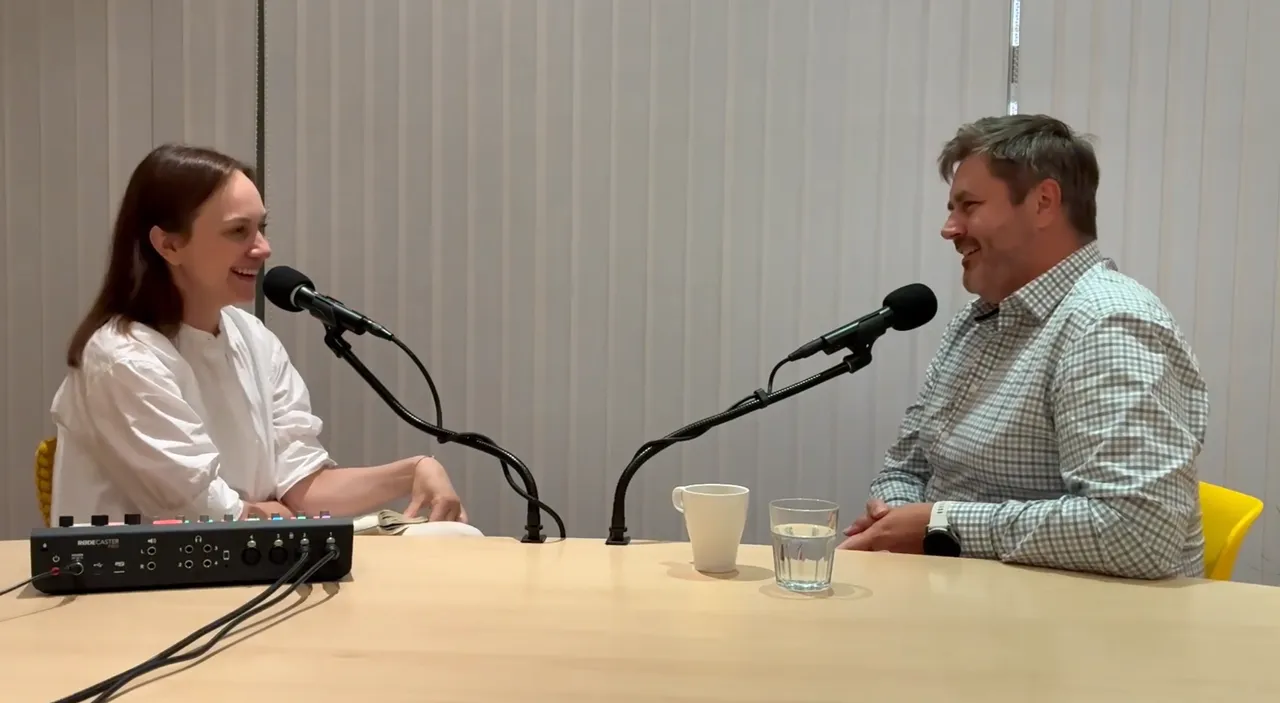
What came up in the conversation (and why it's worth a listen):
The glasses we're born with
Tomáš explains why one person can smoke eighty cigarettes a day and never get lung cancer - while someone standing right next to them, who never smoked at all, does.
"We're each born with glasses. Some are half-empty, some are nearly full, some have nothing in them at all. And through everything we do, they keep getting topped up, one way or another. The problem starts the moment the glass overflows."
You can smoke forty, fifty, eighty cigarettes a day and never get lung cancer. And next to you stands someone who never smoked, not even passively, and suddenly gets it anyway. Either it's predisposition, or their glass was already fairly full - and it simply overflowed.
A birthday gift: the flight that was about something more
He was seven when he flew on a plane for the first time - a dream birthday present. At the same time, it let his parents secretly bring medicine back from abroad for his sister Nika, twelve years his senior, who had fallen seriously ill.
As Tomáš puts it:
"I've been in close contact with oncology since early childhood. And I don't approach tumours the way other people do, because it's a story that ran through my whole childhood."
"Luboš, I'm going to disappoint you."
After medical school, a prestigious position at the Pilsen oncology department was waiting for him. He turned it down.
"Luboš, I'm going to disappoint you - I can't join you."
"Why?"
"Well, because of my sister. If there were a girl there who's twenty, and I saw her, I wouldn't be able to keep my professional distance. I can't be a clinical oncologist."
How many times have you chosen a different path than the one others expected of you?
What if there were a drug that let you eat anything and never gain weight
A classmate from medical school once told him that the pharmaceutical industry is a dirty business - that companies deliberately make drugs with side effects, just so they can profit from treating those side effects too. Tomáš offered her a different question in return.
"If a pharmaceutical company could invent a drug that let you eat like there's no tomorrow and never gain an ounce - would that be great?"
She said yes. And that's exactly the blockbuster every pharmaceutical company in the world dreams of. Except, unfortunately, it can't be done that way - not yet.
Titanium, or iron?
Tomáš sees the pitfalls of the Czech healthcare system.
"If I break my leg and need an implant, it's entirely up to the treating doctor whether they give me one made of titanium or iron. As a patient, I can't even pay extra for the titanium - because the system isn't set up for that."
In his view, Czechia has long avoided one question: not what counts as above-standard care, but what the actual standard looks like. Until we know that, treatment isn't decided by clear rules, but by whatever materials a given department happens to have under contract.
A pharmaceutical company is adding a smart ring to its weight-loss drugs
Drugs today don't stop at the active substance. Pharmaceutical companies are increasingly interested in the whole breadth of a patient's life - because one of their biggest problems is what's called compliance: whether the patient actually takes the drug the way they're supposed to.
"The pharmaceutical industry tries to offer patients different tools to monitor their treatment and see its effect. Because a patient whose condition stabilises and stops getting worse often doesn't even realise the treatment is helping them."
A concrete example from this summer: an unnamed pharmaceutical company is offering patients on weight-loss drugs a free starter kit for the Oura smart ring. The ring tracks biometric data in real time and links it to the treatment programme - so the patient can see the treatment is working, while the company keeps their attention on taking it regularly.
Weight-loss drugs are a good aid, Tomáš says - but without a change in lifestyle, their effect is only temporary. The moment someone stops taking them, without having picked up new eating habits along the way, the yo-yo effect comes back.
What else comes up in the conversation?
- burnout, and the phone call after which nothing was ever the same again,
- artificial intelligence in drug development - where it helps, and where he still doesn't trust it,
- the worst piece of advice he's ever received, and why he'll never pass it on to his son,
- and a story from a McDonald's in Florenc that's stayed etched in his memory.
And to close, the sentence he sends out into the world:
"Trust your instincts. I'm afraid we've become so comfortable that we're losing our own selves. We let ourselves be shaped by circumstances, by technology. Let's not lose ourselves in it."
Happy reading, happy listening - until next time. 👋🏻
Take good care.
Tomáš and Viki are waving at you.